


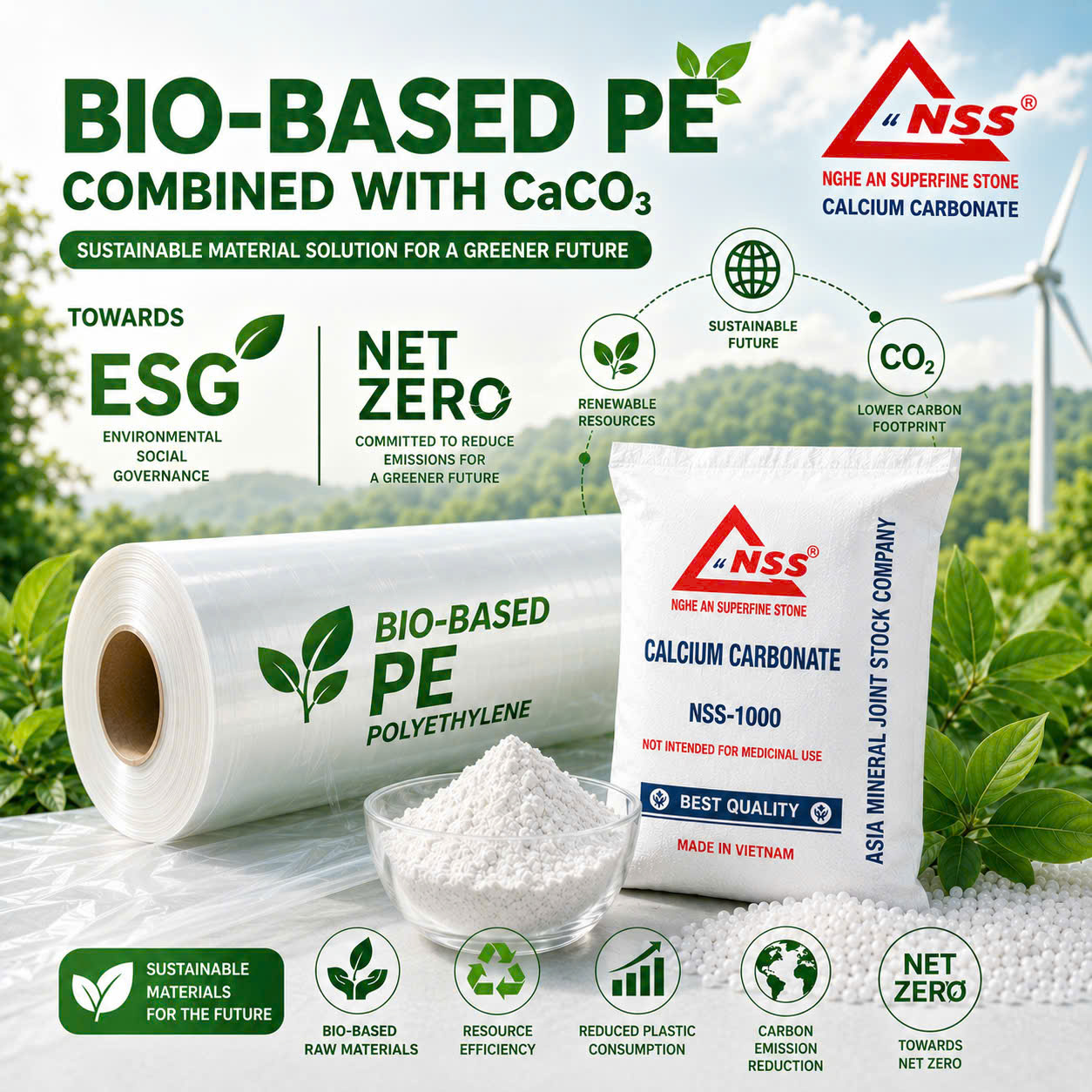
A Sustainable Material Solution Supporting ESG and Net Zero Goals
Shaping the Future with Sustainable Materials
As sustainability becomes a strategic priority across industries, the plastics sector is undergoing a significant transformation. Today, success is no longer measured solely by performance and cost efficiency, but also by the ability to reduce carbon emissions, optimize resource utilization, and contribute to a circular economy.
Around the world, businesses are integrating Environmental, Social, and Governance (ESG) principles into their corporate strategies while committing to Net Zero targets. This global transition is driving strong demand for innovative materials that combine high performance with a lower environmental footprint.
One of the most promising solutions is the combination of bio-based polyethylene (Bio-PE) and calcium carbonate (CaCO₃), delivering materials that offer outstanding technical performance, cost efficiency, and reduced lifecycle carbon emissions.
Bio-Based PE – A New Generation of Sustainable Polymers
Bio-based polyethylene (Bio-PE) is produced from renewable biological feedstocks while maintaining the same molecular structure and material properties as conventional polyethylene. This enables manufacturers to process Bio-PE using existing extrusion, injection molding, and blow molding equipment without requiring major modifications to production lines.
The adoption of Bio-PE offers several important advantages:
- Reduced dependence on fossil-based resources.
- Lower greenhouse gas emissions across the product life cycle.
- Compatibility with existing PE recycling systems.
- Support for corporate sustainability initiatives and circular economy strategies.
- Compliance with increasing market demand for environmentally responsible materials.
For many global brands, incorporating low-carbon materials into their products has become a key requirement for building sustainable supply chains and achieving long-term environmental objectives.
Calcium Carbonate – Optimizing Performance and Resource Efficiency
Calcium carbonate (CaCO₃) is one of the most widely used mineral fillers in the plastics industry due to its ability to enhance product performance while reducing production costs. When surface-treated with stearic acid, CaCO₃ exhibits improved compatibility with polymer matrices, ensuring excellent dispersion and processing performance.
Integrating CaCO₃ into Bio-PE formulations provides numerous benefits, including:
- Reduced polymer consumption per product.
- Improved stiffness and dimensional stability.
- Enhanced processing efficiency during extrusion and injection molding.
- Reduced shrinkage after molding.
- Improved surface appearance and product consistency.
- Lower raw material costs without compromising product quality.
This combination allows manufacturers to maximize resource efficiency while maintaining excellent mechanical performance.
Supporting ESG and Net Zero Strategies
As sustainability requirements continue to evolve, selecting materials with a lower carbon footprint has become an essential component of corporate ESG strategies.
Bio-PE combined with CaCO₃ enables manufacturers to:
- Reduce the carbon intensity of plastic products.
- Increase the proportion of renewable materials in their product portfolio.
- Improve resource efficiency throughout manufacturing.
- Support corporate ESG objectives and sustainability reporting.
- Meet growing customer expectations for environmentally responsible materials.
- Contribute to long-term Net Zero roadmaps through material innovation.
For manufacturers serving packaging, consumer goods, construction, and industrial markets, adopting sustainable material solutions strengthens competitiveness while meeting the environmental expectations of international customers and supply chain partners.
Versatile Applications
Bio-PE/CaCO₃ compounds are suitable for a wide range of applications, including:
- Flexible packaging
- Shopping bags
- Garbage bags
- Agricultural films
- Industrial packaging
- Bottles and closures
- Household products
- Plastic sheets
- Injection-molded components
- Pipes and plastic fittings
Because Bio-PE shares the same processing characteristics as conventional polyethylene, manufacturers can transition to more sustainable materials without significant investment in new processing equipment.
Creating Value for Customers and the Environment
Bio-PE combined with calcium carbonate is more than an alternative material—it represents a strategic approach to creating long-term value for both businesses and the environment.
By reducing reliance on fossil-based polymers, increasing renewable material content, and optimizing polymer usage through high-performance mineral fillers, manufacturers can lower environmental impacts while maintaining product quality and economic competitiveness.
These advantages also strengthen corporate sustainability credentials, helping companies satisfy the growing expectations of customers, investors, and regulatory authorities regarding responsible manufacturing and environmental stewardship.
Driving the Transition Toward a Low-Carbon Future
The transition to low-carbon materials is accelerating across global industries. By combining Bio-PE with calcium carbonate, manufacturers can develop products that balance performance, cost efficiency, and sustainability.
Investing in innovative material solutions today is more than a technological advancement—it is a strategic decision that enhances competitiveness, reinforces brand value, and supports the global transition toward a more sustainable and circular economy.
As businesses continue pursuing ESG excellence and Net Zero ambitions, Bio-PE/CaCO₃ materials are expected to play an increasingly important role in shaping the future of the plastics industry.